
Alloy Wheel Repair Before & After: Three Workshop Case Studies

A before and after photo is satisfying to look at, but on its own it only tells you half the story. What matters is the judgement behind it: what the damage actually was, whether the wheel was safe to repair, and what the right outcome was for the customer. These three case studies walk through everyday jobs from the workshop, one for each of our main services, and explain the thinking as much as the finish.
The short version
Most kerbed, corroded and lightly buckled wheels can be restored to a safe, tidy standard. Some cannot. In each case below the finish looks the part, but the decision that came first — repair, refurbish or replace — is the part that keeps a wheel safe on the road. Every wheel is assessed on its own condition, and where a wheel falls outside safe limits we say so, even when that means turning the work away.
Case study 1 — Diamond cut wheels: lacquer failure and corrosion
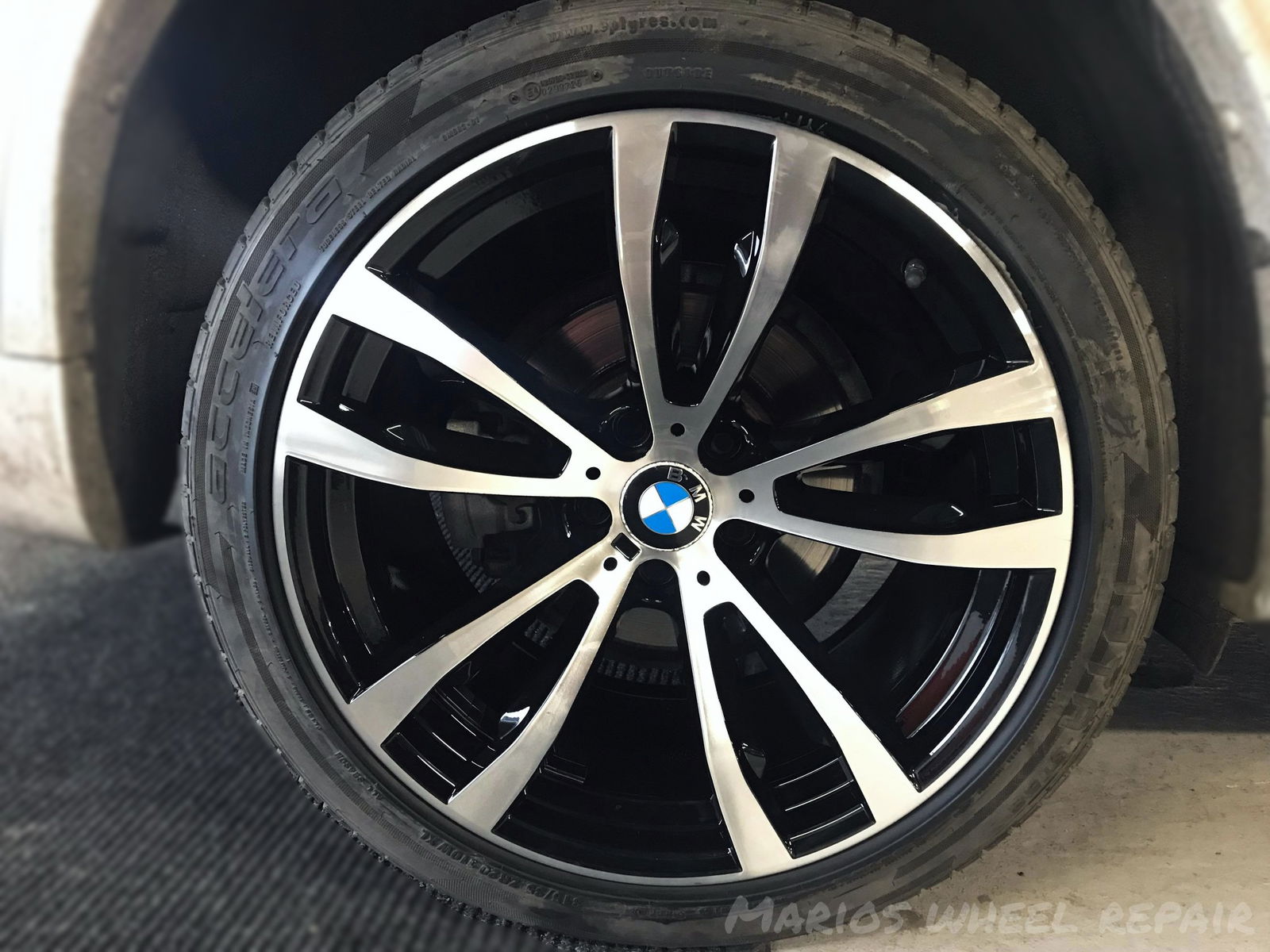
What came in: a set of diamond cut wheels with a cloudy, milky look across the machined face and fine white corrosion creeping in from the rim edge. The owner had noticed it spreading over a winter and assumed the wheels were ruined.
What was actually happening: diamond cut faces rely on a thin layer of clear lacquer to protect the bare machined metal underneath. Once that lacquer is chipped or starts to lift at the edge, moisture gets under it and the aluminium begins to oxidise — which is exactly what the milkiness and white bloom were. The wheels were structurally sound; the problem was finish failure, not damage to the wheel itself. Our guide to diamond cut wheels, corrosion and re-cut limits explains why this finish is less forgiving than paint.
What we did: the old lacquer was removed, the corrosion treated, and the face lightly re-cut on the lathe to restore the crisp machined pattern before being re-lacquered and cured. The important caveat we gave the customer up front: a diamond cut face can only be re-cut a limited number of times, because each cut removes a little material. These wheels had plenty of life left, but we always flag where a wheel is approaching that limit. For the dedicated service, see diamond cut alloy wheel repair.
Outcome: a clean, factory-style two-tone finish and an honest conversation about how to make it last — regular cleaning and dealing with any fresh chips early, before moisture gets a foothold again.
Case study 2 — Full refurbishment and colour change: a kerbed, corroded set
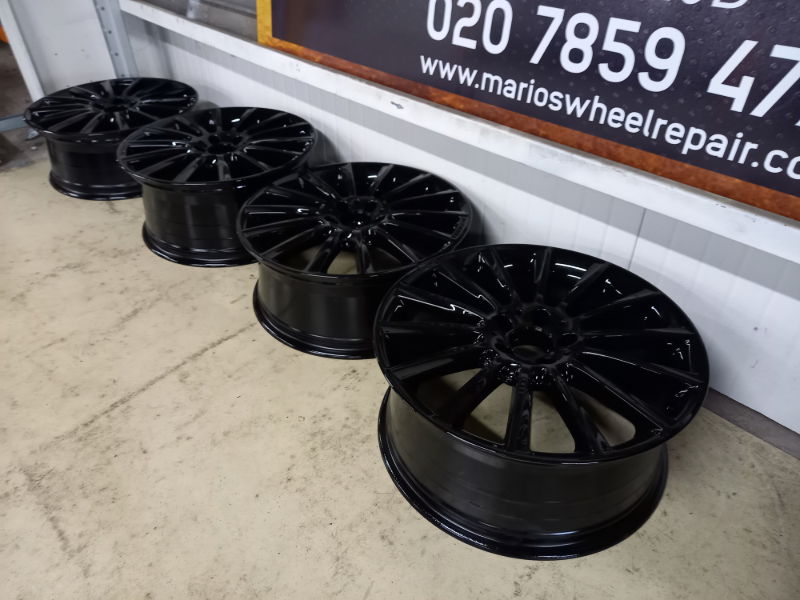
What came in: a full set of tired silver wheels with kerb rash on several spokes, chipped lacquer and the early stages of corrosion at the rim edges. The owner wanted them all matching again and was considering a colour change to gloss black.
The assessment: the damage was cosmetic rather than structural — kerb scuffs and surface corrosion, no cracks or bends. That made all four wheels good candidates for a full alloy wheel refurbishment. The part most people underestimate is preparation: the wheels are stripped back so the corrosion can be removed properly, not painted over. Sealing contamination under a fresh finish is exactly how a "repair" reappears within a season.
What we did: each wheel was stripped, the corrosion dealt with, and the wheels powder coated in the chosen gloss black — a finish that tends to stand up well to UK road salt and kerb contact when it is prepared and applied properly. Powder coating also gives an even, hard-wearing result across a full set, which matters when you want four wheels to look identical.
Outcome: a consistent, durable set that looks like a factory option rather than a respray. Because the customer was changing the specification's appearance rather than the fitment, no structural or load-rating change was involved. Costs for work like this depend on the finish and condition, so we quote from the wheels themselves — you can see typical guidance on our prices page.
Case study 3 — Structural repair: a pothole crack and buckle
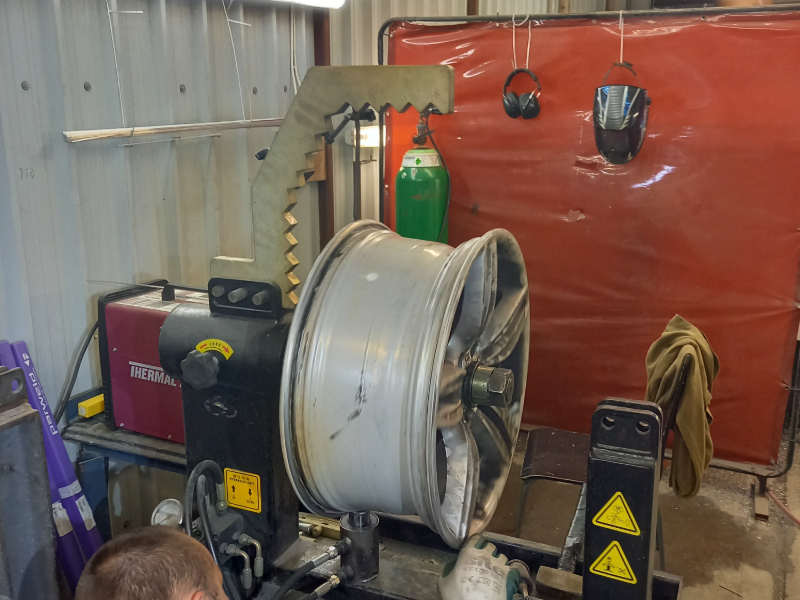
What came in: a single wheel after a heavy pothole strike. The car had developed a steering vibration at motorway speed and the tyre was slowly losing pressure. On inspection there was a buckle on the rim and a crack running along the inner barrel — the sort of damage that is easy to miss because it sits where you cannot see it from the outside.
Why this one needed care: this is where appearance and safety part company. A buckle can often be straightened back to true, and many cracks can be safely welded — but not all of them. The deciding factors are where the crack is, how it runs, and whether the area is load-bearing. A crack in a high-stress zone, or one combined with severe deformation, can fall outside safe repair limits. We assess that before committing to a repair, because a tidy weld on a wheel that should have been replaced is worse than no repair at all.
What we did: the crack in this case was in a repairable location. It was prepared and TIG welded in aluminium, the buckle straightened, and the wheel checked for run-out and pressure sealing before it went back on the car. The vibration and the slow puncture both traced back to this one wheel. If the crack had been in a structural zone, our advice would have been replacement — a call we explain in our guide on whether to repair or replace an alloy wheel.
Outcome: a wheel running true again with the vibration gone and the tyre holding pressure — and a customer who understood exactly why it was safe to repair rather than being told simply that it "looked fine".
What these case studies have in common
Three very different jobs, one consistent approach. In each case the finish is the easy part to photograph; the value is in the inspection that came first. Diamond cut wheels have a finite number of safe re-cuts. A full refurbishment is only as good as its preparation. A structural repair depends entirely on where the damage is — and sometimes the honest answer is replacement.
If you are weighing up whether your own wheels are worth repairing, two guides are a good starting point: our damaged alloy wheel safety checklist for deciding whether a wheel is safe to keep driving on, and our complete guide to alloy wheels for the wider picture. Buying a used car or a fresh set of wheels? Our alloy wheel buying guide covers what to check before you commit.
Frequently Asked Questions
Are these before and after case studies real jobs?
Yes. They are representative examples of work that regularly comes through the workshop, described honestly. Customer and vehicle details have been kept general for privacy, but the type of damage, the decisions made and the outcomes reflect real, everyday jobs across London and Essex.
Does a good before and after photo mean the repair is structurally safe?
Not on its own. A wheel can look perfect and still be structurally compromised, and a tidy finish can hide a repair that should never have been attempted. Appearance and safety are separate questions. Every wheel is inspected on its own condition, and a visually successful result is only worthwhile when the wheel underneath it is sound.
Can any damaged alloy wheel be refurbished?
No. Cosmetic damage, corrosion and many bends can be repaired within safe limits, but cracks in high-stress areas, severe deformation, deep pitting or wheels weakened by previous heavy repairs may fall outside those limits. Where that is the case, the honest recommendation is replacement rather than a refinish that only restores the look.
How long does a typical refurbishment take?
It depends on the damage, the finish and how many wheels are involved. A single cosmetic repair is usually quick, while a full strip, colour change or structural repair takes longer because the preparation and inspection stages cannot be rushed. We give a realistic turnaround once we have seen the wheels.
How do I get a quote for my own wheels?
The most reliable quote comes from an inspection, because the price depends on the material, finish and exactly where the damage is. You can bring the car in or send a few clear photos to start, and we will give honest advice on whether repair or replacement is the right call before any work begins.
Want an honest assessment of your own wheels?
We repair, refurbish and straighten alloy wheels across London, Essex & surrounding areas — and we will tell you honestly when replacement is the safer call. Bring the car in or send a few photos to start.
A note on these examples
These case studies are representative and anonymised. The right outcome for any wheel can only be confirmed by inspecting that individual wheel — usually after it has been stripped — because material, finish, previous repairs and the exact location of damage all affect what is safe. Where damage falls outside safe limits, the safe outcome takes priority over the cosmetic one.
Damaged or scuffed alloy wheels?
Mario's Wheel Repair restores kerbed, scratched, buckled and corroded alloys across London & Essex. Explore our alloy wheel repair, full refurbishment, diamond cut, powder coating and wheel straightening services.
Get a free wheel assessment →

